Lean and Agile thinking at IKEA

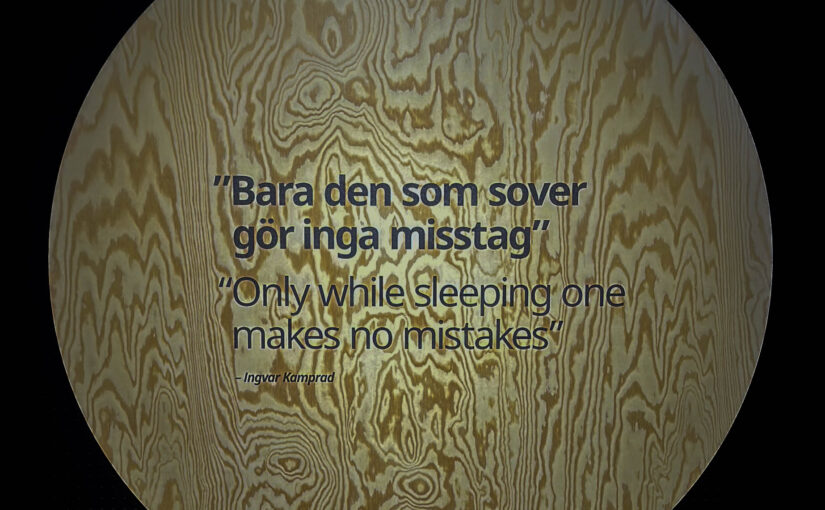
“Only while sleeping one makes no mistakes.”
“Bara den som sover gör inga misstag” – Ingvar Kamprad

💡 This quote perfectly captures a mindset rooted in curiosity, courage, and continuous learning — and it was a pleasant surprise to stumble upon it where I did.

After a vacation in Finland, we were driving back through Sweden and decided to make a stop in Älmhult to visit the IKEA Museum. We expected to see a nostalgic collection of furniture through the decades — and we did — but there was much more to discover:

📌 An exhibition on women in design
📌 A biographical section about Ingvar Kamprad
📌 And, perhaps most interestingly, a deep dive into IKEA’s design and production philosophy

Kamprad’s quote reflects a culture that embraces experimentation and sees mistakes as part of progress. And it made me reflect.

Back in the 2000s, when I was actively engaged in the Agile and Lean movement, most of the origin stories pointed to Toyota — and how their production principles emerged from post-war scarcity in Japan.

So it was fascinating to see a parallel story in Swedish furniture design, also born out of scarcity — in the rural region of Småland — where resource constraints, pragmatism, and ingenuity shaped a culture of continuous improvement and value-driven design.

In that sense, the story of IKEA is a brilliant complement to understanding Lean and Agile thinking — and a reminder that innovation often begins where resources are limited, but mindset is expansive.

If you’re ever driving through southern Sweden, the museum is well worth a visit. And yes — there are cinnamon buns and Swedish meatballs in the restaurant 🇸🇪

This was first posted on LinkedIn
On the AI journey towards productivity

Now that the AI-hype may have peaked it is exciting to see how AI can be implemented successfully in the business, with a strategy that focus on use cases where the technology consistently can deliver reliable results and measurable value.

In my own field of IT I see AI used to enhance the quality of documentation, accelerate development with customized boilerplate code and create comprehensive unit test that improve that improve software reliability. It also assists with daily tasks such as summarizing long mail threads and organizing messy notes into a readable state. All time-consuming tasks that it is convenient to automate.

As such, the focus of implementingAI tools is to human capabilities rather than replacing them. It is an exciting journey towards better quality and higher productivity.

This was first posted on LinkedIn

The theater and how to get there

This Sunday I was at the Royal Theater in Copenhagen, to watch “Store balletskoledag. When a Danish ballet school is to show their best, this is the place to be. It gives even the youngest students an chance to try the stage and experience what life as a performer can be like. Great fun.

But first we had to get there, and that turned out more exciting than planned. It seemed so simple, and that is a reminder to always be careful about making assumptions. When planning it is not enough to know “when” to meet (or make delivery), the “where” also matters, be that a physical place (or a site or server somewhere). Also, accounting for delays in the overall plan can save the day if you stay cool and pragmatic.

This was first posted on LinkedIn

Summer reading 2023

Weather is getting better, so I will also do a summer book post.

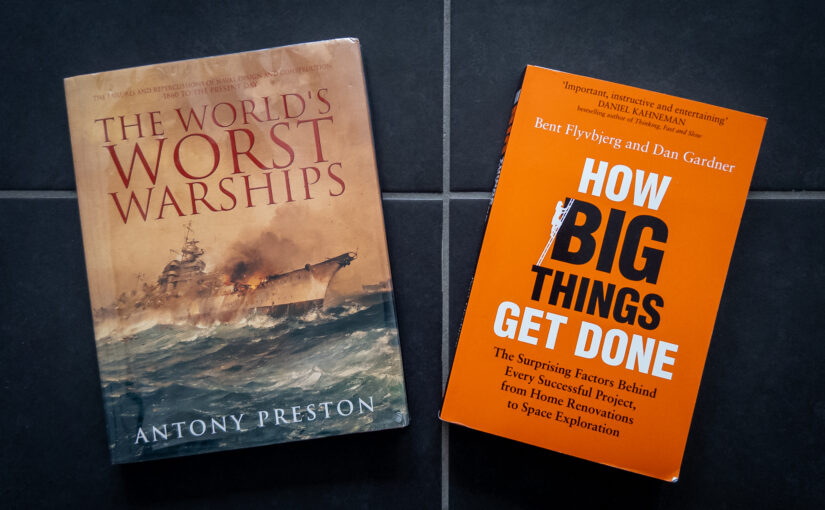
‘How Big Things Get Done’ by Bent Flyvbjerg and Dan Gardner, and ‘The Worlds Worst Warships’ by Antony Preston. Both take an interesting, readable and enjoyable look at mega projects and how they succeed or fail. Flyvbjerg and Gardner look forward at how we can do better; Preston’s view is more historical, but at a complex subject “…which encompasses engineering, economics, sociology , and even psychology”, with outcomes that may be ridiculous, often tragic and sometimes change the path of history.

As an IT manager of people and projects I particularly enjoyed these books because they provide an outside perspective on the challenges I meet in my daily work, including that IT projects aren’t worse or better than others (actually it depends: Flyvbjerg and Gardner got statistics).

Next up in my reading list in non-fiction must be ‘In Search of Stupidity’ by Merrill Chapman which is now out in a 3rd edition, with a fresh look at the latest mistakes within technology marketing.

This was first posted on LinkedIn

Summer storming, norming and performing

Posterity repost
https://www.linkedin.com/posts/allan-harsmann-517762_summer-time-for-vacation-at-the-sea-and-activity-7091665764432130048–mQQ?utm_source=share&utm_medium=member_desktop

Summer: Time for vacation at the sea and a great opportunity to catch up with friends and family.

When I met with an older relative, I was reminded that Tuckman’s model (cf. this previous post) can apply whenever groups are formed and reformed. So there was a bit of storming too when the experienced view that nothing ever changes (at least not for the good) met the optimistic view that new concepts and technologies always bring salvation.

Both parties are right and wrong: Experience tells what issues should be addressed and ensures that history does not repeat itself; and new technologies and ideas may provide solutions if done right. If the two views are combined successfully (norming, that is), then optimism can be transformed into progress.

(About the picture: A reminder that what looks like a storm may just be windy weather – still, the pier in Nr. Vorupør at the Jutland North Sea is always worth a look)

This was first posted on LinkedIn